# From Giants to Ghost Villages:
The Llŷn Peninsula juts out into the Irish Sea from the northwest corner of Wales like a crooked finger pointing towards Ireland. It is one of the most beautiful and unspoilt places in Britain, and also one of the most historically layered. Beneath the sheep-cropped turf of its headlands and the quiet lanes of its villages lie thousands of years of human story — from Neolithic burial chambers to Iron Age hillforts, from medieval pilgrim trails to Victorian quarrying communities, from the fires of Welsh nationalism to the gentle persistence of a language that has survived everything history has thrown at it.
## The First Peoples: Stone Age to Bronze Age
People have lived on the Llŷn for at least five thousand years. The evidence is written in stone — literally. Neolithic burial chambers, or cromlechs, can be found at Bachwen near Clynnog Fawr, at Cefnamwlch near Tudweiliog, and at several other sites across the peninsula. These communal tombs, built from massive stone slabs that would have required considerable cooperative effort to raise, tell us that organised, settled communities were farming this land long before the pyramids were built.
By the Bronze Age, around 2000 BC, the peninsula’s inhabitants were building cairns on the hilltops — including the substantial burial cairn on the summit of Yr Eifl, the triple-peaked mountain that dominates the northern coast. This cairn would later be incorporated into one of the most remarkable archaeological sites in all of Britain.
## Tre’r Ceiri: The Town of the Giants
The Llŷn’s archaeological crown jewel is Tre’r Ceiri, an Iron Age hillfort perched 450 metres above sea level on the slopes of Yr Eifl. Its name translates as “Town of the Giants,” and when you stand among its ruins on a clear day, with the entire peninsula spread out below you and the sea glinting on three sides, the name feels entirely appropriate.
Built around 200 BC and occupied continuously through the Roman period until at least the fourth century AD, Tre’r Ceiri is widely regarded as the finest hillfort in Wales and one of the best-preserved in all of Europe. Its stone rampart still stands up to 3.5 metres high in places, complete with a parapet walk along the top and narrow entrance passages designed to funnel attackers into killing zones. Inside the walls, the remains of over 150 stone roundhouses are clearly visible — a densely packed settlement that has been described as a “Welsh Pompeii” for its remarkable state of preservation.
The people who lived here farmed the lower slopes, kept livestock, and would have traded with communities across the Irish Sea. The hilltop position wasn’t just defensive — it was a statement of power and permanence. Other significant hillforts on the peninsula include Garn Boduan near Nefyn and Carn Fadryn above Garnfadryn, both of which show evidence of later reuse as fortified residences by medieval Welsh princes.
## Saints and Pilgrims: The Age of Faith
The arrival of Christianity transformed the Llŷn. In the sixth century AD, St Cadfan crossed from Brittany and established a monastery on Bardsey Island, beginning a tradition of religious devotion that would define the peninsula for the next thousand years. His follower St Hywyn founded the church at Aberdaron, St Beuno established his great monastery at Clynnog Fawr, and dozens of smaller churches were built across the landscape, each dedicated to a local Celtic saint whose name often survives in the village name — Llan-aelhaearn (the enclosure of Aelhaearn), Llan-bedrog (the enclosure of Pedrog), Llan-engan (the enclosure of Einion).
Bardsey became known as Ynys Enlli, the “Island of 20,000 Saints” — a reference to the monks, hermits and holy men buried there over the centuries. When Pope Callixtus II declared in 1119 that three pilgrimages to Bardsey equalled one to Rome, the peninsula became one of the great pilgrimage routes of medieval Christendom. For over four hundred years, pilgrims walked the chain of churches from Clynnog Fawr to Aberdaron, supporting a network of inns, ferrymen and communities that depended on the pilgrim trade.
## Maritime Communities: Fishing, Shipbuilding and the Sea
The sea has always shaped life on the Llŷn. By the medieval period, almost every coastal settlement was engaged in fishing — Nefyn was a major herring port, and crab and lobster fishing was practised from Aberdaron, Abersoch, Porthdinllaen and countless smaller coves. Shipbuilding flourished at Nefyn, Aberdaron, Abersoch and Llanaelhaearn, with locally built wooden vessels trading around the Irish Sea and beyond.
Porthdinllaen, the sheltered cove on the north coast now famous for the Tŷ Coch Inn on its beach, was once seriously considered as the main packet port for Ireland. It narrowly lost out to Holyhead in a parliamentary vote, a decision that probably preserved the Llŷn’s tranquil character for the next two centuries. Had the vote gone differently, Porthdinllaen might today be a bustling harbour town rather than one of the most idyllic spots on the Welsh coast.
The maritime tradition collapsed in the late nineteenth century when steel-hulled ships replaced wooden ones, but its legacy lives on in the Llŷn Maritime Museum in Nefyn, housed in the old church of St Mary, where anchors, ship models, photographs and artefacts from wrecks tell the story of the peninsula’s deep relationship with the sea.
## Quarries, Mines and the Lost Village
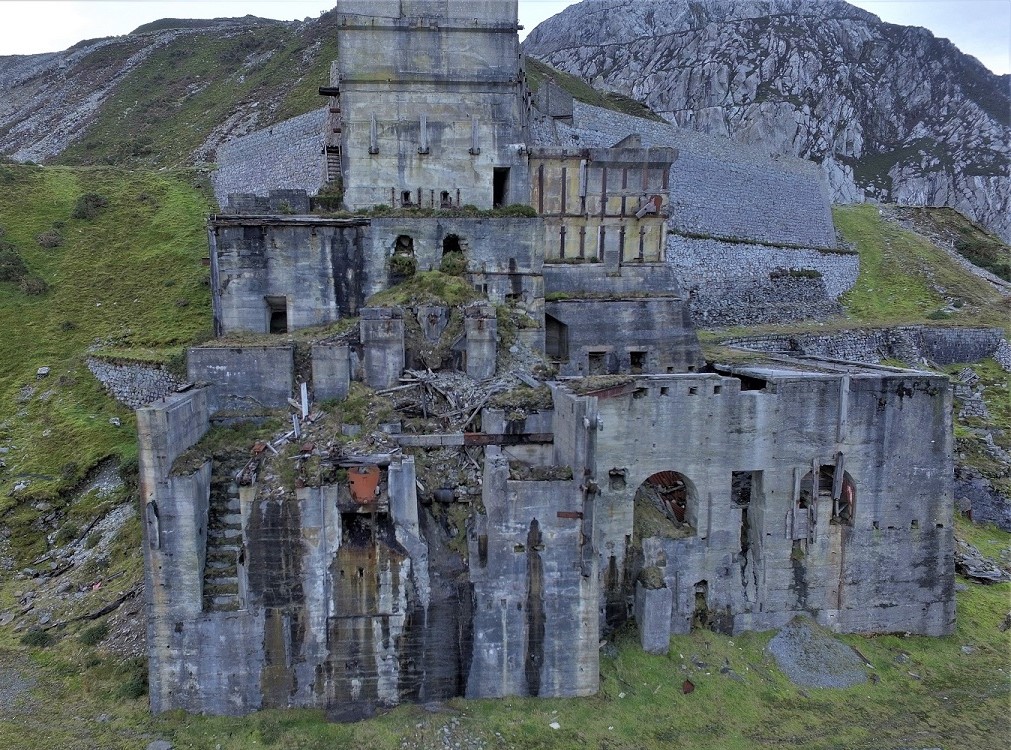
The Industrial Revolution touched the Llŷn more gently than many parts of Wales, but it left its mark. The granite quarries of the northern coast, particularly around Yr Eifl, produced setts — the stone blocks used to surface roads — that were shipped out from small harbours along the coast. The quarries were the reason villages like Trefor and Llithfaen grew, and their legacy is written in the landscape in the form of steep inclines, ruined quays and scarred hillsides.
The most poignant reminder of this industrial past is Nant Gwrtheyrn, the “lost village” tucked into a remote valley on the north coast beneath Yr Eifl. The quarrying community of Porth y Nant lived here in extraordinary isolation — their goods shipped in and out by sea, with limited contact with the outside world. When the quarry closed during the Second World War, the community dispersed and the cottages fell into ruin.
For decades, Nant Gwrtheyrn was a ghost village, its empty buildings slowly returning to nature. Then, in a story that perfectly encapsulates the Welsh spirit of cultural preservation, the site was acquired by a local trust, restored, and reborn as the National Welsh Language and Heritage Centre. Today, it attracts over 30,000 visitors a year and runs residential Welsh language courses in the renovated cottages — a place once abandoned by industry now thriving as a guardian of the language.
Copper, zinc and lead mining also had a presence on the peninsula, particularly around Llanengan near Abersoch, while the manganese mines at Y Rhiw on the southern coast produced nearly 200,000 tons of ore between 1894 and 1945.
## Tân yn Llŷn: The Fire That Ignited a Movement
In 1936, the Llŷn Peninsula became the unlikely crucible of modern Welsh nationalism. The British government announced plans to build a bombing school at Penyberth, near Pwllheli — a decision made after protests had successfully blocked similar projects elsewhere in England. The choice of the Llŷn, one of the heartlands of the Welsh language, was seen as a deliberate provocation.
A petition representing half a million Welsh people was delivered to Prime Minister Stanley Baldwin, who refused to meet the delegation. In response, three prominent Welsh nationalists — Saunders Lewis, D.J. Williams and Lewis Valentine — set fire to building materials at the Penyberth site and then turned themselves in to police. Their trial was moved from Caernarfon to the Old Bailey in London, where the jury failed to reach a verdict, and a retrial convicted them. The three served nine months in prison.
The “Fire in Llŷn” — Tân yn Llŷn — became a defining moment in Welsh political history, galvanising the Welsh language movement and demonstrating a willingness to take direct action in defence of cultural identity. The event is still commemorated today, and its echoes can be felt in every bilingual road sign, every Welsh-medium school, and every conversation conducted in Welsh on the streets of Pwllheli and Aberdaron.
## Tourism and the Modern Llŷn
Tourism arrived on the Llŷn with the railway, which reached Pwllheli in 1867. The town expanded rapidly, with hotels and grand houses appearing along the seafront. Abersoch, once a fishing village built around the River Soch, began its transformation into the fashionable seaside resort it is today. After the Second World War, Butlins established a holiday camp at Penychain (now Hafan y Môr), which brought visitors from the industrial cities of Lancashire and the Black Country.
Today, the peninsula balances tourism with its deep-rooted Welsh identity. Over 94% of school-age children can speak Welsh, making the Llŷn one of the strongest heartlands of the language. The designation of the entire peninsula as an Area of Outstanding Natural Beauty protects its landscape from overdevelopment, while the community works to ensure that the influx of visitors and second-home owners doesn’t dilute the culture that makes the place special.
The Llŷn in 2026 is a place where Iron Age hillforts overlook organic farms, where medieval pilgrim churches sit alongside surf schools, and where the same language spoken by the builders of Tre’r Ceiri two thousand years ago is still the first language of the children playing on the beach at Aberdaron. That continuity — ancient, resilient, quietly extraordinary — is the real history of the Llŷn Peninsula.
—
*Discover the history, heritage and communities of the Llŷn Peninsula at llyn.live — your local guide to Pen Llŷn.*
Leave a Reply